 |
| The front door at the Culinary Institute of America at Greystone in St. Helena, California |
In June 2013 the U.S. Highbush Blueberry Council invited me to accompany a group of corporate chefs for a workshop on cooking with blueberries at the Culinary Institute of America at Greystone in Napa Valley. Are you thinking that I might be the luckiest food blogger on the planet? Me too.
Breakfast conversation when you're eating with corporate chefs:
"Do you have your own bakery? Yeah, me neither."
"I could save them a ton of money if I had a butcher on-site, but we just don't have the physical space."
"The one thing I tell students is make sure you look people in the eye when you're interviewing. There's nothing worse than bringing in a candidate for a job in my kitchen and having him look at the floor the entire time."
"Actually, doing a barbecue for 5,000 people isn't as hard as you think. My team's pretty much got it down."
"When we did that pastry competition, we had to store all the sugar sculptures on the desk in my office - it was the only place in the kitchen with air conditioning."
 |
| The corporate chefs with CIA Greystone instructor Lars Kronmark |
If the Blueberry Council had brought fine dining chefs to the Culinary Institute of America at Greystone to play with blueberries, maybe we would have been talking about foie gras, Michelin stars and molecular gastronomy. But the 16 corporate chefs and foodservice executives in our group talked about stuff much closer to my heart, the nuts and bolts of the food business: staffing, purchasing, margins, menu development, physical plant, corporate politics.
I found the business discussions fascinating and asked a million questions. How many people does it take to serve 4,000 meals a day (to Eric Ernest, Executive Chef at the University of Southern California)? How do you decide whether to let an entrepreneur buy into your franchise (to David Goldstein, Chief Operating Officer of Sharky's)? Do you use social media to market your new menus to students when you take over the dining halls at a new state school account (to David Aylmer, Regional Executive Chef for Chartwells)?
Our group included titles like Director, Food and Beverage; Senior Director of Training; Culinary Manager, On Site Food Service; and a few Executive Chefs or Corporate Executive Chefs. Most of them, but not all, had gone to culinary school. Many had been in the food business since puberty. While each chef had taken a different path through the world of restaurants and corporate kitchens, all landed in jobs that are a lot more management and a lot less hands-on cooking.
And yet the minute they got behind the stoves, aprons wrapped around waists, toques balanced carefully on heads, you could see the joy - and the chops. These chefs knew exactly what they were doing, and they did it with confidence, ease, care, and a whole lot of flair.
 |
| The corporate chefs in the CIA's Viking-equipped teaching kitchen |
The point of the workshop: to introduce these corporate chefs to
blueberries as a savory menu item. This wasn't about blueberry muffins or blueberry pie. Under the expert tutelage of CIA Chef Instructor Lars Kronmark, the corporate chefs used blueberries in salsas, salads, marinades, sauces, savory cheese puffs, and sandwiches. And not just fresh blueberries: The group also got to experiment with dried, freeze-dried, powdered, and pickled blueberries, as well as Chef Lars's homemade blueberry vinegar.
 |
| The inside of a freeze-dried blueberry |
 |
| Blueberry products: dried, dehydrated, powder, concentrate, puree, and fresh |
 |
| Chef Lars made an intense, savory blueberry jam (secret ingredient: saba, concentrated grape must) |
Why does it make sense for the Blueberry Council to spend a boatload of money flying in corporate chefs from around the country to focus on blueberries? It's pretty simple: Supply and demand. As Mark Villata, the Blueberry Council's Executive Director told the group, the number of acres planted in highbush blueberries in the U.S. has more than doubled since 2005, to 231,000 acres as of last year. What's more, Chile has also ramped up cultivation and export of highbush blueberries. New varieties and higher yields mean more blueberries for sale all year round. The Blueberry Council's job is to create demand for all that new fruit.
On the first day, Chef Lars broke the group into four teams and assigned each team a few hand-picked recipes to execute. One was more complicated and delicious than the next: Turkish zucchini pancakes with feta and blueberries; tabbouleh with parsley, cinnamon and blueberries; Taiwanese-style baby ribs with five-spiced blueberry sauce. I have a mental block when it comes to plating, so I was awed by the artful presentation of the dishes that came out of the CIA's beautifully equipped Viking kitchen. And then - the best part - we ate their creations for lunch.
 |
| Chef Lars giving the group its marching orders |
 |
| Dividing the work |
 |
| USC's Eric Ernest |
 |
| Steven Scaia, Executive Chef, Redmond Marriott Town Center |
 |
| Jeremy Bringardner, Corporate Executive Chef, LYFE Kitchen |
 |
| Kristian Forrest, Executive Chef, ARAMARK Higher Education |
 |
| Dan Phalen, Corporate Executive Chef for Luby's Fuddruckers Restaurants |
 |
| David Aylmer of Chartwells |
 |
| Sharky's COO David Goldstein |
 |
| Korean bulgogi-style beef marinating; it was served topped with pickled blueberries |
 |
| Making fried wonton skins with duck leg confit and blueberries |
 |
| Five-spiced blueberry sauce for baby ribs |
 |
| Penny Poorman, Catalina Restaurant Group's Director of Food and Beverage, with ham and blueberry gougeres (cheese puffs) |
 |
| Crispy masa boats with chorizo, topped with cheese and fresh blueberries |
 |
| Blueberry gougeres (cheese puffs) with arugula |
 |
| Lamb chops with blueberry glaze |
 |
| Smoked chicken and blueberry tostadas with spicy red salsa |
The second day's session in the Viking kitchen featured a
Chopped-style competition, where each two-person team had to create two "small plates"-style dishes using a mystery protein, ingredients from Chef Lars's pantry, and blueberries. That's when the chefs' personal styles really shone through. John Byrne of US Foods, ever the Irish lad, stuck with lamb; Jeremy from LYFE Kitchen made a clean quinoa salad; Eric Ernest from USC channeled his inner Asian to make blueberry
banh mi sandwiches. Each team stood up and presented its dishes. And then we ate.
 |
| Bernardo Coelho, Executive Chef at Restaurant Associates, with teammate Stefan Riemer, one of Disney's head pastry chefs |
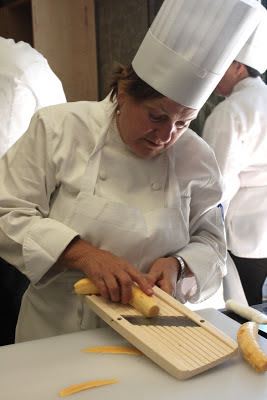 |
| Penny Poorman slicing plantains |
 |
| Steak in a blueberry marinade |
 |
| Blueberry banh mi (Vietnamese sandwich) |
 |
| Guacamole with blueberry-dusted tortilla chips |
 |
| Beef carpaccio "lollipops" with blueberry filling |
 |
| Blueberries and pork on fried masa cakes |
 |
| Fritters and a French Dip-like sandwich with blueberry sauce |
 |
| Blueberry-marinated ribs |
 |
| Empanadas with blueberry dipping sauce |
 |
| Turkey and blueberry quenelles with plantain chips |
 |
| Fried quail egg and blueberry pancake breakfast stacks |
 |
| Quinoa and blueberry bowl |
 |
| Blueberry marinated flank steak with exquisite plating - those words were written in chocolate on the plate |
 |
| Stefan Riemer and Bernardo Coelho |
 |
| Andrew Edwards and Penny Poorman |
 |
| Kristian Forrest and Dan Phalen |
 |
| Michael Freeman, Senior Director of Training for McAlister's Deli, and David Goldstein of Sharky's |
 |
| Eric Ernest and Jeremy Bringardner |
 |
| US Foods' John Byrne and Deanna Day, Culinary Manager for Rich's Products Corporation |
 |
| Steven Scaia and David Aylmer |
And there was more. A blueberry tasting, where we tried blueberries in every form paired with savory elements like pork rinds, butter, and salt. One dinner at the CIA's restaurant, another at the
Alpha Omega winery (with a barrel tasting, my very first!). A molecular gastronomy demo by Chef Lars, blueberry ice cream made with liquid nitrogen. Wine pairings with tiny blueberry appetizers. By the time the workshop was over, we were well fed, well educated, and well satisfied.
There was consensus at the end: Blueberries rock in savory dishes. Everyone left with new ideas about how to use blueberries in all their forms in their corporate menu planning. Mission accomplished.
Thanks to the Blueberry Council for including me in this wonderful workshop and paying for my travel. For more blueberry recipes and nutritional information, visit the Blueberry Council's website or connect with them on Facebook, Twitter, Pinterest, and YouTube.


